What Tools Do Foundation Repair Companies Use?
You’re lying in bed at 2 AM, and there it is again – that subtle creaking sound from downstairs. Your mind starts racing… is that just the house settling, or something more serious? You’ve noticed that hairline crack in your living room wall has gotten a bit wider over the past few months, and now you’re wondering if you should be worried.
Here’s the thing – foundation problems don’t announce themselves with dramatic fanfare. They’re more like that friend who slowly distances themselves… you don’t notice at first, but then one day you realize things have definitely shifted. And just like with health issues, catching foundation problems early can save you thousands of dollars and a whole lot of stress.
But here’s where it gets tricky. When you finally decide to call in the professionals (because let’s face it, YouTube University only goes so far), you’re often left wondering what exactly these foundation repair experts are doing down there in your basement or crawl space. Are they using some kind of mystical divining rods? High-tech gadgets that cost more than your car? Or is it all just… looking around and making educated guesses?
The truth is, foundation repair has come a long way from the days of contractors eyeballing problems and crossing their fingers. Today’s professionals use an impressive arsenal of diagnostic tools that would make CSI investigators jealous. But unlike those TV crime dramas where everything gets solved in 60 minutes (minus commercials), real foundation assessment requires patience, precision, and the right equipment.
Think about it this way – you wouldn’t want your doctor to diagnose you just by looking at you from across the room, right? Same principle applies to your house. Modern foundation repair companies use specialized tools that can literally see inside your walls, measure microscopic movements, and detect problems that are invisible to the naked eye.
Some of these tools are surprisingly high-tech… we’re talking laser levels that can detect a variance of less than an eighth of an inch, ground-penetrating radar that maps what’s happening beneath your foundation, and moisture meters that can tell exactly where water is causing problems (even when you can’t see or smell it). Others are more traditional but equally important – like the simple crack gauge that monitors whether that concerning fissure is actively growing or has stabilized.
And honestly? Understanding what tools these companies use isn’t just about satisfying your curiosity (though I get it – it’s pretty fascinating stuff). It’s about being an informed homeowner who can ask the right questions and spot the difference between a thorough professional and someone who’s just winging it.
Because here’s what nobody tells you about foundation problems – they’re often symptoms of multiple issues working together. That crack might not just be about settling; it could be related to drainage problems, soil conditions, or even changes in your local water table. The companies that really know what they’re doing use multiple diagnostic tools to build a complete picture, not just treat the obvious symptoms.
I’ve seen too many homeowners get burned by contractors who show up with nothing more than a flashlight and a clipboard, then propose expensive solutions based on… well, not much. On the flip side, I’ve also watched homeowners panic when they see legitimate professionals using what looks like expensive, complicated equipment – wondering if they’re being oversold on unnecessary testing.
So what should you expect when the foundation repair team shows up at your door? What tools separate the pros from the pretenders? And perhaps most importantly – how can you tell if all that diagnostic equipment is actually necessary, or if someone’s padding their bill?
We’re going to walk through the essential tools that reputable foundation repair companies use, from the basic but crucial measuring devices to the sophisticated diagnostic equipment that can predict problems before they become catastrophic. You’ll learn what each tool actually does (in plain English, not contractor-speak), when it’s appropriate to use them, and what red flags to watch for.
Because when it comes to your home’s foundation, knowledge really is power… and peace of mind.
The Hidden World Beneath Your Feet
You know that feeling when you’re walking through your house and notice a door that suddenly won’t close properly? Or maybe there’s a hairline crack appearing near your window frame that definitely wasn’t there last month. Well, here’s the thing – your foundation might be trying to tell you something.
Think of your foundation like the roots of a massive tree. Just as tree roots can shift, settle, and sometimes struggle against changing soil conditions, your home’s foundation is constantly dealing with forces you can’t see. Clay soil that expands when it rains, then shrinks during dry spells. Underground water that decides to change course after a particularly wet season. It’s actually pretty amazing that foundations hold up as well as they do, considering all the drama happening in the dirt below.
Why Foundations Move (And Why That’s Not Always Bad)
Here’s something that might surprise you – foundations are supposed to move a little. I know, I know… that sounds terrifying when you’re talking about the thing holding up your entire house. But think about it like your joints. A completely rigid knee would break the first time you tried to walk down stairs. Similarly, a foundation that couldn’t flex at all would crack at the first sign of soil movement.
The problem comes when that movement goes beyond what engineers call “acceptable limits.” And honestly? Those limits are pretty conservative, which is good news for homeowners but sometimes means repair companies get called in for issues that look scarier than they actually are.
The Detective Work Begins
Before any repair company starts swinging hammers or digging holes, they need to figure out what’s actually going wrong. This is where things get interesting… and where the right tools make all the difference.
Foundation problems are like medical symptoms – the thing you can see (that crack, that sticking door) is rarely the actual problem. It’s just your house’s way of saying “Hey, something’s not quite right down here.” The real issue might be
– Soil that’s washing away from one side of your foundation – A plumbing leak that’s been slowly saturating the ground for months – Poor drainage that’s letting water pool where it shouldn’t – Natural settling that’s finally caught up with a house built on less-than-ideal soil
Reading the Clues Your House Leaves Behind
Foundation repair pros are basically house detectives, and they’ve gotten really good at reading the story your home tells through its cracks, gaps, and shifting surfaces. But here’s what’s tricky – houses are terrible witnesses. They can’t tell you when problems started, how fast they’re progressing, or what might have triggered them in the first place.
That’s why the measurement and assessment phase is so crucial. A crack that’s been stable for five years is completely different from one that’s grown an inch in the past month. Water damage from a one-time plumbing disaster requires a different approach than ongoing moisture issues.
The Physics of Keeping Houses Level
Let’s talk about what’s actually happening when a foundation needs repair. Imagine you’re trying to keep a heavy bookshelf perfectly level on a floor that’s slowly becoming uneven. You’ve got a few options: you can prop up the low spots, anchor down the high spots, or sometimes you need to actually lift and reposition the whole thing.
Foundation repair works on similar principles, just with a lot more weight involved and consequences that go way beyond a few crooked books. The tools used have to be precise enough to make tiny adjustments (we’re talking fractions of an inch here) but strong enough to handle loads that would make a crane operator nervous.
When “Good Enough” Isn’t Good Enough
Here’s something that catches a lot of homeowners off guard – foundation repair often involves making things better than they were originally. Modern repair techniques and tools can actually create a more stable foundation than what many homes started with, especially if we’re talking about houses built several decades ago.
It’s counterintuitive, right? You’d think you’re just trying to get back to where you started. But soil conditions change over time, building codes improve, and frankly… some foundations were just barely adequate to begin with. Sometimes “repair” is really “upgrade,” which explains why quality foundation work can seem expensive until you consider what you’re actually getting.
Getting Smart About Equipment Before You Sign
Here’s what most homeowners don’t know – you can actually tell a lot about a foundation repair company just by paying attention to their tools. When contractors show up for your estimate, don’t just focus on their sales pitch. Look at what they’re carrying.
The pros? They’ll have a moisture meter, a laser level, and probably a tablet or smartphone with specialized apps for measurements and photos. Companies that roll up with just a tape measure and a notepad… well, that’s your first red flag right there.
Questions That Separate the Pros from the Pretenders
You don’t need to become a foundation expert overnight, but asking a few smart questions will instantly reveal who knows their stuff. Try these
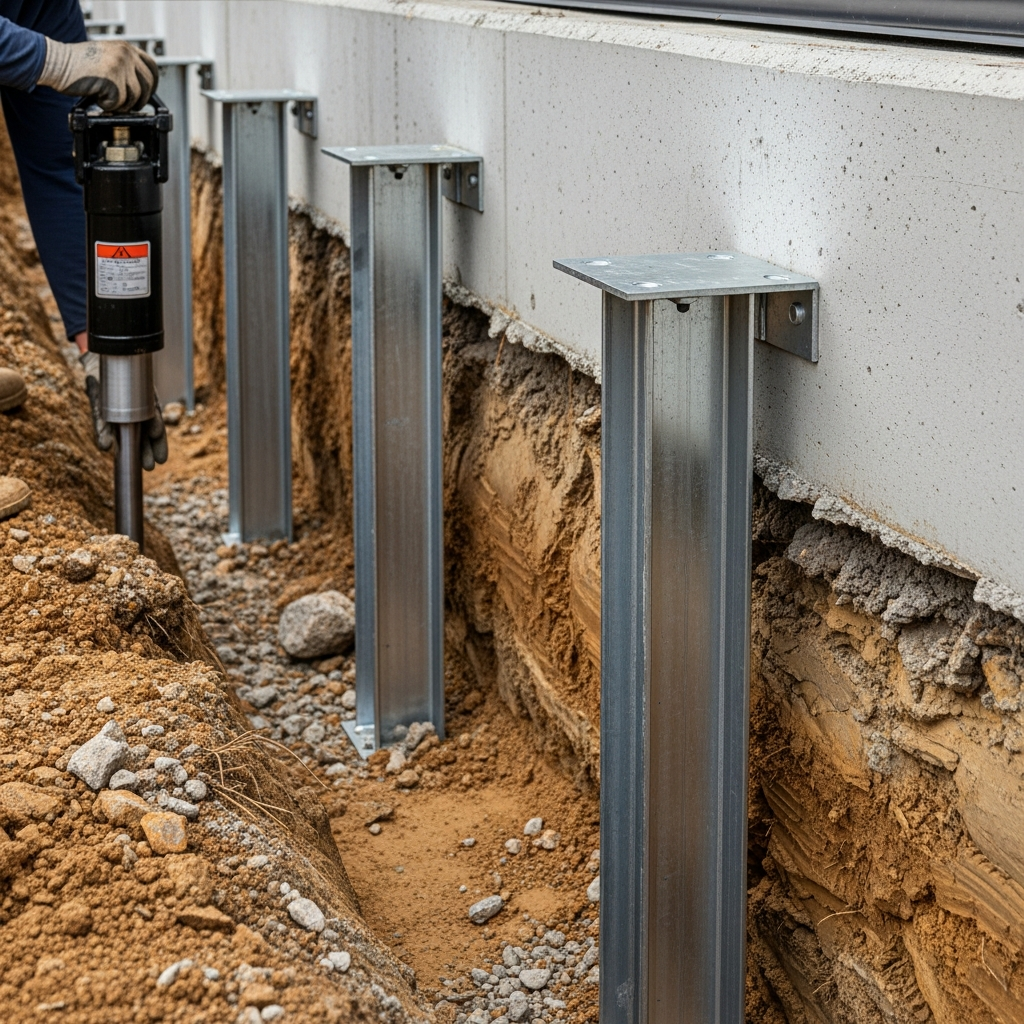
“What type of push pier system do you use, and why?” A quality contractor won’t just say “steel piers.” They’ll explain whether they use round shaft or square shaft systems, discuss load ratings, and maybe even mention specific manufacturers like Foundation Supportworks or Chance.
“How do you determine the bearing capacity?” This one’s a doozy. If they start talking about soil testing, load calculations, and engineering reports, you’re dealing with someone serious. If they give you a blank stare or say something vague about “standard depths”… keep looking.
“Can you show me your hydraulic equipment?” The real pros use hydraulic systems that can generate 20,000+ pounds of pressure. They’ll be happy to walk you around their truck and show off their gear. Companies using manual or lightweight equipment? They’re probably not equipped for serious foundation work.
The Site Visit Reality Check
When contractors come out for estimates, watch how they work. The good ones will spend serious time actually examining your foundation – not just glancing at obvious cracks and writing up a quote.
They should be checking multiple areas around your home’s perimeter, looking at grading issues, testing soil conditions with simple tools, and taking actual measurements. If someone gives you a detailed estimate after a 15-minute walk-around… be very suspicious.
And here’s something nobody tells you – ask to see their previous work. Not photos on their phone (those could be anyone’s), but actual addresses of recent jobs in your area. Most homeowners are happy to show off good foundation work, and driving by gives you a chance to see the quality firsthand.
Red Flags That Should Send You Running
Some warning signs are obvious – like companies going door-to-door after storms or demanding payment upfront. But others are more subtle.
Watch out for contractors who can’t explain their equipment or seem unfamiliar with different pier systems. If they’re pushing one solution for every foundation problem, that’s trouble. Real foundation issues require different approaches – helical piers for some situations, push piers for others, maybe slab jacking or carbon fiber strips for minor settling.
Also be wary of companies that don’t mention permits or engineering. Most serious foundation work requires permits and engineering approval. If they’re suggesting they can “handle all that paperwork” without involving your local building department… that’s not handling it properly.
Making the Equipment Work for You
Here’s a insider tip – ask contractors to walk you through their diagnostic process using their actual tools. A legitimate company will be proud to show you how their laser level reveals foundation settlement patterns, or how their moisture readings indicate water intrusion problems.
This serves two purposes: you learn about your foundation issues, and you get to evaluate their expertise in real-time. Someone who’s comfortable with their equipment and can explain what they’re finding? That’s your person.
Don’t be afraid to ask for a second opinion either, especially on major repairs. Foundation work isn’t cheap – we’re talking thousands, sometimes tens of thousands of dollars. Getting multiple contractors to evaluate your situation with their different tools and approaches often reveals important details the first guy might have missed.
The bottom line? Foundation repair is serious business that requires serious tools and expertise. Companies that have invested in proper equipment and know how to use it effectively are usually the ones you want handling your home’s structural integrity. Take your time, ask questions, and remember – the cheapest bid isn’t always the best value when you’re talking about your foundation.
When the Ground Shifts Under Your Feet (Literally)
Let’s be honest – foundation repair isn’t exactly dinner party conversation. Most homeowners don’t wake up thinking, “Gee, I wonder what moisture meters do!” But here you are, probably because you’ve noticed something unsettling. Maybe it’s that door that won’t close quite right anymore, or those hairline cracks that seem to be… growing?
The thing is, understanding foundation repair tools feels overwhelming because the stakes feel so high. This isn’t like picking the wrong paint color – this is your home’s structural integrity we’re talking about.
The “I Don’t Know What I Don’t Know” Problem
Here’s what trips up most people: you’re trying to evaluate contractors who are speaking what might as well be a foreign language. They’re throwing around terms like “helical piers” and “push piers” while you’re just trying to figure out if your house is going to fall down.
One contractor shows up with a basic level and gives you a quote. Another arrives with a truck full of high-tech equipment and quotes three times as much. How do you know who’s right?
The solution isn’t becoming an expert overnight – it’s learning to ask the right questions. When a contractor mentions their tools, ask them to explain what they’re looking for and why. A good contractor should be able to explain why they need a laser level versus a regular one, or what that moisture meter is telling them about your specific situation.
Don’t be embarrassed to ask for clarification. Actually, contractors often appreciate clients who are engaged enough to ask questions – it usually means they care about getting things done right.
The “Sticker Shock” Reality Check
Let’s talk about what nobody wants to discuss upfront – foundation repair is expensive, and the fancier tools often mean higher costs. When you see a contractor with hydraulic jacks, concrete pumps, and computerized monitoring systems, your wallet might start feeling lighter before they even give you a quote.
Here’s the uncomfortable truth: sometimes you do get what you pay for. That contractor with the basic hand tools might charge less, but if your foundation needs precision work, those savings could cost you more in the long run.
The key is understanding which tools are actually necessary for your specific problem. A small crack might not require the same equipment arsenal as a foundation that’s settled significantly. Ask contractors to explain which tools they’ll use and why – and don’t be afraid to get a second opinion if the approaches seem drastically different.
When Weather Becomes the Enemy
Foundation repair companies face a challenge that affects their tool selection but homeowners rarely consider: weather doesn’t care about your timeline. Concrete work needs specific conditions. Excavation equipment can’t work effectively in saturated soil. Even high-tech monitoring equipment can give skewed readings in extreme temperatures.
This creates a frustrating situation where you want the work done ASAP (especially if you’re dealing with water issues), but the contractor keeps postponing. It feels like they’re making excuses, but often they’re being responsible.
The solution? Build buffer time into your expectations and ask upfront about weather-related delays. A good contractor will explain how weather affects their specific repair methods and tools. They might also suggest interim solutions to protect your foundation while waiting for ideal working conditions.
The Technology Gap Challenge
Modern foundation repair increasingly relies on sophisticated tools – laser levels, ground-penetrating radar, computerized monitoring systems. But here’s what’s tricky: not every contractor has embraced these advances equally.
You might get quotes from one company using cutting-edge equipment and another relying on methods that haven’t changed much in decades. Both might be perfectly competent, but they’re operating with different toolkits entirely.
The real challenge isn’t picking the most high-tech option – it’s understanding when technology actually matters for your situation. Sometimes traditional methods work just fine. Other times, you really do need those precision instruments.
Ask contractors to explain their diagnostic process and why they’ve chosen their particular approach. The right contractor will be honest about both the capabilities and limitations of their tools.
Making Peace with the Process
Look, foundation repair is rarely straightforward. Even with all the right tools, surprises happen. Soil conditions vary, hidden damage emerges, and sometimes initial assessments need adjustment.
The contractors who acknowledge this uncertainty upfront – and explain how their tools help them adapt – are usually the ones you want on your side. Because at the end of the day, it’s not just about having the fanciest equipment… it’s about having the experience to use it wisely.
What Should You Actually Expect Timeline-Wise?
Let’s be honest here – foundation repair isn’t like ordering takeout. You’re not getting same-day service, and anyone who promises that is probably someone you want to avoid.
Most foundation issues that require professional intervention take anywhere from 3-7 business days to complete, assuming we’re talking about standard repairs like pier installation or crack sealing. Now, if you’ve got a massive structural issue that requires underpinning half your house… well, that’s a different story entirely. We’re looking at weeks, not days.
The weather plays a bigger role than you might think. Heavy rain can shut down excavation work faster than you can say “waterlogged soil.” And in winter? Some repairs simply have to wait. Concrete doesn’t cure properly in freezing temperatures, no matter how fancy the equipment.
Here’s what typically happens: initial assessment (usually same day or next), detailed estimate (2-3 days), scheduling (this is where things get interesting – could be next week, could be next month depending on severity), then the actual work begins.
The Waiting Game – And Why It Exists
I know, I know… you want this fixed yesterday. Your stress levels are through the roof, you’re losing sleep, and every little creak in the house has you wondering if today’s the day everything collapses. (Spoiler alert: it’s probably not.)
But here’s the thing – good foundation companies are usually booked out for a reason. They’re not sitting around twiddling their thumbs. Emergency situations get bumped to the front of the line, sure, but most foundation issues have been developing for months or even years. Another few weeks isn’t going to make or break anything.
The companies with immediate availability? Sometimes that’s a red flag. Not always – maybe they just had a cancellation – but it’s worth asking why they’re so readily available when everyone else is backed up.
What Happens Once the Work Begins
The first day is usually the loudest. That’s when they’re bringing in the heavy equipment – the hydraulic piers, the excavators, sometimes those massive concrete trucks that barely fit down your driveway. Your neighbors are definitely going to notice.
Most crews start early (we’re talking 7 AM early) and work until mid-afternoon. They’ll clean up each day, but let’s manage expectations here – your yard is going to look like a construction zone for a while. There’s really no way around it.
Communication varies wildly between companies. Some will give you daily updates, others… well, you might have to track down the foreman if you want to know what’s happening. Ask upfront about their communication style so you know what to expect.
The Reality Check About “Guarantees”
Every company will offer some kind of warranty or guarantee, but read the fine print. A lifetime warranty sounds amazing until you realize it’s only valid if you have them come back for annual inspections at $200 a pop.
Most legitimate warranties cover the actual repair work for 10-25 years, assuming normal settling and no major environmental changes (like that giant oak tree you planted right next to your foundation… yeah, that might void things).
And here’s something they don’t always mention upfront – foundation repair often reveals other issues. Once they start digging, they might find drainage problems, or discover that crack wasn’t just cosmetic after all. Budget for potential surprises.
Moving Forward Without Losing Your Mind
Get everything in writing. Everything. The timeline, the warranty terms, what happens if they find additional problems, who’s responsible for permit fees (if needed), cleanup expectations – all of it.
Don’t feel pressured to sign immediately, even for “emergency” situations. A reputable company will give you time to think it over. The high-pressure sales tactics? That’s usually a sign to walk away.
And once you’ve chosen a company and the work begins? Try to be patient with the process. Yes, it’s disruptive. Yes, it’s stressful. But foundation repair is genuinely complex work that can’t be rushed without risking your home’s stability.
Your house has probably been dealing with this issue for longer than you realize. A few more days to do it right won’t hurt anything – but cutting corners definitely could.
Taking the Next Step Forward
You know what? After learning about all these specialized tools – from those impressive hydraulic jacks to the high-tech laser levels – it’s pretty clear that foundation repair isn’t exactly a weekend DIY project. And honestly, that’s okay. Sometimes the smartest thing we can do is recognize when something’s beyond our wheelhouse.
The thing is, foundation problems have this sneaky way of making us feel overwhelmed. One day you notice a small crack, and suddenly you’re lying awake at night wondering if your house is slowly sinking into the earth. (Spoiler alert: it’s probably not.) But those worries? They’re completely valid. Your home is likely your biggest investment, and when something feels off with the foundation… well, everything else feels a bit shaky too.
Here’s what I’ve learned after years of talking with homeowners: the companies that really know their stuff – the ones with all these sophisticated tools we’ve been discussing – they’re not trying to scare you into expensive repairs. The good ones will come out with their concrete scanners and moisture meters, do a thorough assessment, and give you straight answers. Sometimes that answer is “actually, this isn’t as bad as you think.” Other times, it’s “we need to address this, but here’s exactly how we’ll fix it.”
The arsenal of tools these professionals bring isn’t just impressive – it’s reassuring. When someone shows up with a concrete scanner instead of just eyeballing your foundation, you know they’re serious about getting to the root of the problem. When they use laser levels to measure settlement down to the millimeter, that’s precision you simply can’t get any other way.
But here’s the thing that matters most: you don’t have to figure this out alone. Those stress-filled nights of googling “foundation crack repair” at 2 AM? You can put those behind you. The companies that invest in proper equipment – and more importantly, train their teams to use it correctly – they’re there to help you sleep better, not worse.
Foundation issues feel scary because they’re literally about the ground beneath your feet. But with the right professionals and the right tools, most problems are entirely manageable. That hairline crack might need monitoring, not major intervention. That slight settling could be addressed with a straightforward repair that takes a day, not a month.
If you’re dealing with foundation concerns right now – whether it’s cracks, settling, moisture issues, or just that nagging feeling that something’s not quite right – don’t let it eat at you. Reach out to a reputable foundation repair company for an assessment. Most offer free evaluations, and you’ll get real answers from people who know how to use all those specialized tools we’ve talked about.
Your peace of mind is worth that phone call. And who knows? You might discover that what’s been keeping you up at night is actually a pretty straightforward fix. Sometimes the unknown is scarier than the reality… and sometimes, the reality is that everything’s going to be just fine.